Singapore’s Property Tax Hike in 2023: Why, What, and How?
There are some things that are certain in life. The inexorable march of time, death, and of course, taxes.
Recent reports in local mainstream media have highlighted that property tax will increase for most Singapore homes in 2023 – and though this may come as fresh news to some, others may recall that this hike was first announced in Finance Minister Lawrence Wong’s Budget 2022 speech earlier this year.
If you’re already aware of the upcoming changes, more power to you (but you’ll still have to pay your taxes), and if you aren’t, here’s what Singapore homeowners can expect to see on their tax statements in the near future.
But first, why the need for a property tax hike?
Let’s address the elephant in the room. Come 2023, life in Singapore will get more expensive.
Between inflationary pressures and the impending Goods and Services Tax (GST) rate change, which too will kick in next year (ouch!), locals can expect to fork out more for everything they consume.
So, why then a property tax hike? This can be answered by the Government’s use of property tax as the “principal means of taxing wealth” in Singapore to mitigate social inequalities.
Likewise, progressive taxes on cars and income serve a similar function, with received monies going towards initiatives for economic development, national defence, and government administration.
Or as the Inland Revenue Authority of Singapore (IRAS) puts it: “Taxes are used to develop Singapore into a stronger community, a better environment, and a more vibrant economy, a place that Singaporeans can be proud to call home.”
What are the new property tax rates in 2023?
In a nutshell, if you’re currently living in a property that you own, it’ll be subject to owner-occupier rates, whereas non-owner-occupier tax rates will apply for properties that you own, but don’t reside in.
And although there are two phases slated for the property tax hike – with the first kicking in on 1 Jan 2023 and the second taking place in 2024 – this guide focuses solely on the former.
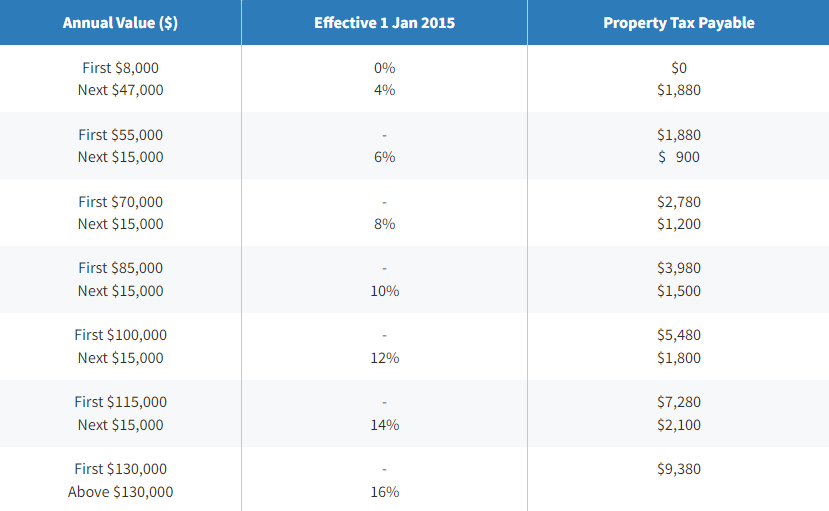
Owner-occupier tax rates since 2015 (old):
Owner-occupier tax rates from 1 Jan 2023 (new):
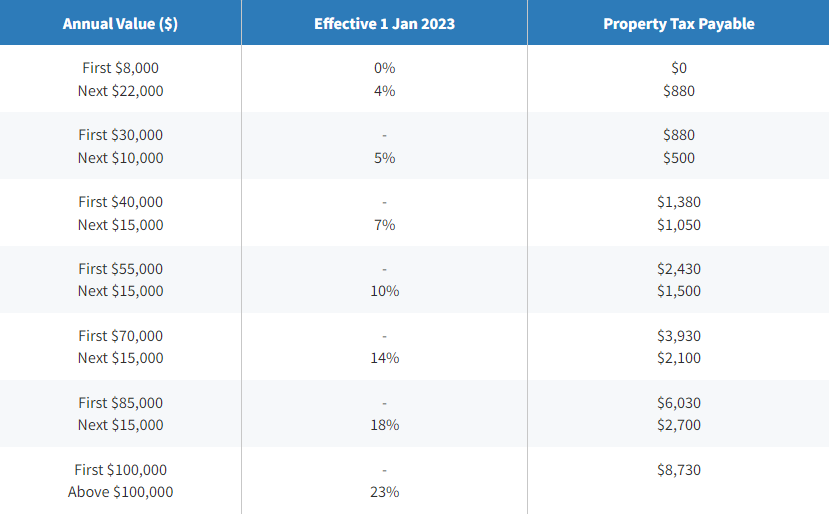
Compared to the existing (read: soon-to-be obsolete) tax system for owner-occupier properties, which was first introduced in 2015, the upcoming one for 2023 not only features new tax rates, but also revised annual value tiers.
At a glance, it can be observed that owner-occupied homes with an annual value of $30,000 or below won’t be subjected to the new rates.
However, the same cannot be said for their counterparts that surpass the new threshold, which depending on their annual value, may be subjected to a property tax rate of up to 23% – representing a 7% jump from the previous upper limit of 16% for owner-occupied homes.
Non-owner-occupier tax rates since 2015 (old):
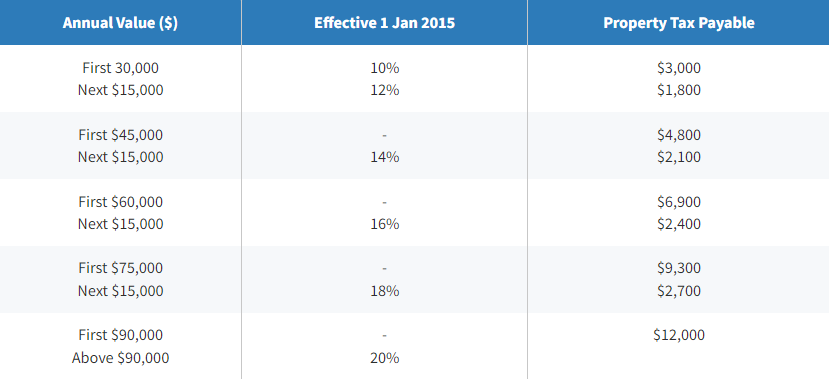
Non-owner-occupier tax rates from 1 Jan 2023 (new):
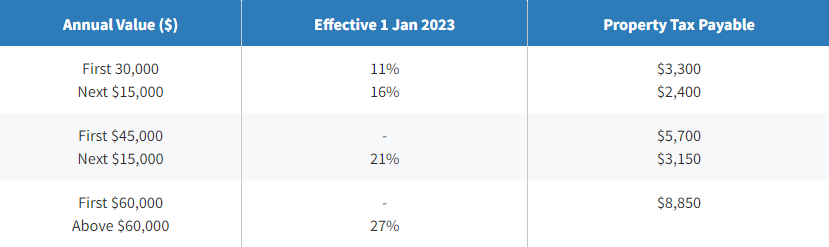
Similarly, the current tax system for non-owner-occupier properties will also see a revision in annual value tiers as well as rate hikes in 2023.
Notably, under the revised framework, all properties with an annual value of above $60,000 will be subject to a tax rate of 27% following the removal of the existing final two annual value tiers on 1 Jan 2023.
How to calculate the amount of property tax you need to pay
If you’d like to calculate how much the annual property tax on your home will be, you’ll first need to find out its annual value, which will in turn tell you the tax tier it falls under.
As defined by IRAS, the annual value of a property is its “estimated gross annual rent if it were to be rented out, excluding furniture, furnishings and maintenance fees” – and you can find out exactly how much it is by logging into mytax.iras.gov.sg.
Once done, you can apply the numbers you’ve gathered to the following formula for a rough answer:
Annual value of property (AV) x applicable property tax rate = property tax payable
For example, if you’re the owner and occupier of a property with an annual value of $40,000, the math will be as such…
| Annual Value of Property | New owner-occupier tax rate | Property tax amount |
| First $8,000 | 0% | $0 |
| Next $22,000 | 4% | $880 |
| Next $10,000 | 5% | $500 |
$0 + $880 + $500 = $1,380 in property taxes is what you’ll have to pay.
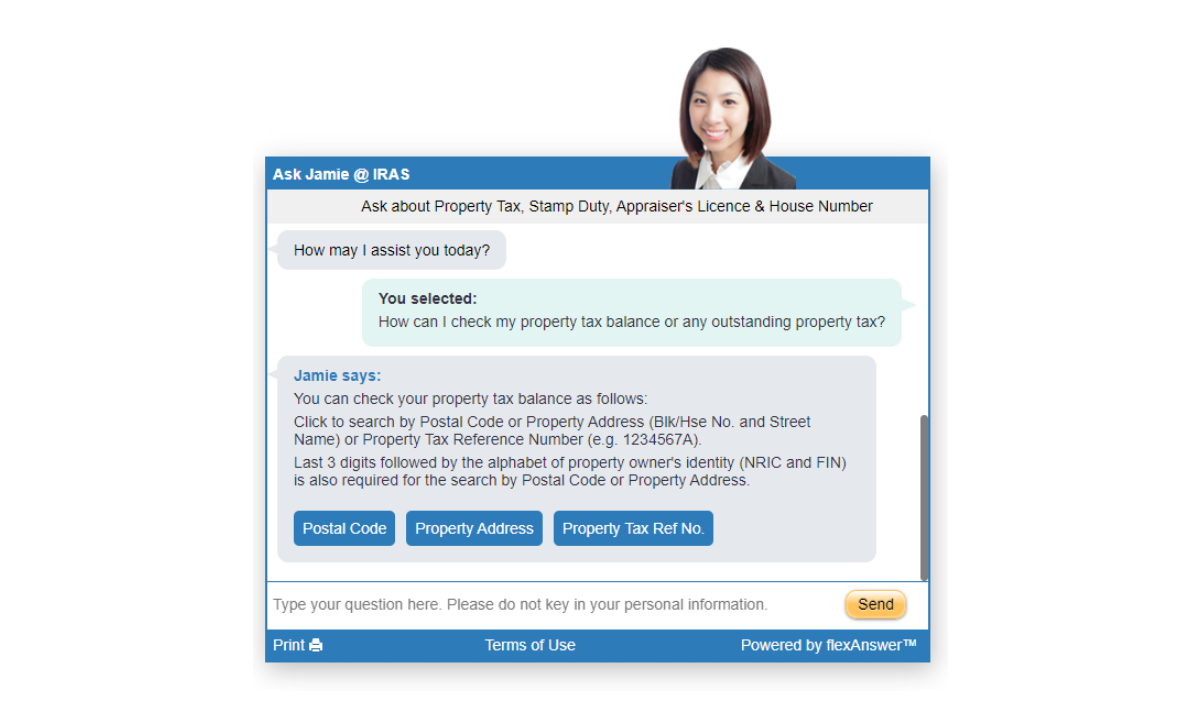
Alternatively, you can always Ask Jamie (click here to access the virtual assistant) for assistance.
There are two reasons why you’ll want to do so, the first being that the above method of calculation doesn’t account for any subsidies or rebates that you may be eligible for, and the second is because the Government will be revising the annual values for most residential properties in 2023.
Need more help? Feel free to speak to one of our trusted ERA advisors today! Also, for a closer look at the outcomes of the property tax hike, check out this in-depth report by ERA’s Research and Consultancy Team!
Disclaimer for consumers
This information is provided solely on a goodwill basis and does not relieve parties of their responsibility to verify the information from the relevant sources and/or seek appropriate advice from relevant professionals such as valuers, financial advisers, bankers and lawyers. For avoidance of doubt, ERA Realty Network and its salespersons accept no responsibility for the accuracy, reliability and/or completeness of the information provided. Copyright in this publication is owned by ERA and this publication may not be reproduced or transmitted in any form or by any means, in whole or in part, without prior written approval.